

Ph.D. in Physics: Exploring the Universe through Research and Innovation
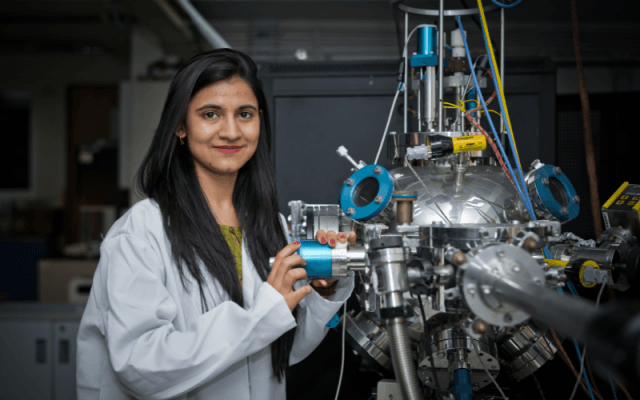
Ever wondered how light curves around a black hole or how a particle can exist in two places at once?
The answers to such mind-bending questions don't just appear, they're uncovered by people who dare to ask why and how. Every great leap in science, from quantum computing to space exploration, began as a spark of curiosity in a physicist's mind.
Recent research by India's Department of Science & Technology, published in Nature Physics suggests that physics is entering an exciting new phase in India. Today's discoveries go beyond laboratories — they're shaping the technologies that define our daily lives. The world no longer needs people who merely learn physics; it needs thinkers who can advance physics - those who can link theory with innovation, and ideas with impact.
So, every science enthusiast eventually asks: “What's the next step if you truly want to explore the universe in its deepest sense?”
It begins with a Ph.D. in Physics — a journey where curiosity transforms into purposeful contribution. It's where you learn to question existing theories, conduct independent research, and uncover truths that could redefine the boundaries of knowledge.
Whether it's quantum systems, nanotechnology, or astrophysics — a Ph.D. doesn't just teach you physics, it empowers you to shape it.
Why Study Ph.D. in Physics?
Many students choose to study Ph.D. in Physics because of the following reasons-
Acquire In-demand Skills
A Ph.D. in Physics provides scholars with the knowledge and training to experiment, theorize, and model mathematically when applying the knowledge to the world. They examine the intricate laws of the natural world in the following realms: optics, classical and quantum mechanics, electromagnetism, astronomy, and biomedical physics.
Lucrative Career Options
Students who have earned a Ph.D. Physics degree can take up any job profiles such as-
Researcher, Scientist, Physicist, Lecturer & Professor, Author & Writer, Journalist, Editor & Critic, Human Services Worker, Independent Consultant, Philosophical Journalist, Industrial R&D Lab professionals, Senior Research Scientist, etc.
Opportunities in a Wide Range of Industries
Students can find job opportunities in industries such as education, medicine, healthcare, research, finance, consulting, IT, Banking, etc.
Ph.D. in Physics Eligibility
Eligibility for a Ph.D. in Physics generally includes:
- A Master's degree in Physics or a closely related field with a minimum academic score
- Clearing national or university level entrance exams like GATE or CSIR-NET
- A solid foundation in research, including prior projects, publications, or research experience
- A clear research proposal specifying the area of interest
- Proficiency in mathematics and computational tools used in physics research
Ph.D. in Physics Duration
The duration of a Ph.D. in Physics typically spans 3 to 5 years, depending on the research scope and specialization:
- Initial Phase- Coursework, reviewing literature, and preparing a research proposal.
- Middle Phase- Conducting experiments or theoretical studies, analyzing data, and publishing initial research.
- Last Phase- Completing advanced research, writing the thesis, and defending the dissertation.
Ph.D. Physics Syllabus
The Ph.D. in Physics program aims to provide a deep understanding of advanced physics concepts combined with significant, research-based analytical skills. Theoretical and experimental physics from topics in statistical mechanics to condensed matter physics are studied by students. Here are some key subjects covered a Ph.D. in Physics syllabus:
- Research Methodology and Statistics
- Mathematical Methods
- Physics Laboratory
- Theoretical Physics
- Experimental Physics
- Statistical Mechanics
- Numerical Methods and Simulation
- Research and Technical Communication
- Nuclear and Particle Physics
- Department Electives
- Condensed Matter Physics
Ph.D. in Physics Curriculum - Main Highlights
The Ph.D. in Physics curriculum leads to an organized program of study in advanced physics, with an opportunity to do in-depth research and gain practical experience. Students will study theory as well as get familiar with the application of scientific principles to real-world problem solving. Here are some highlights of the Ph.D. Physics curriculum:
- Comprehensive training in core physics subjects
- Practical lab work and simulations
- Research methodology and development of analytical skills
- Opportunities for interdisciplinary and innovative projects
- Preparation for academic, industrial, and research roles
Final Takeaway
From the time your brain starts thinking to itself about how light is distorted around a black hole until you publish your first paper, a Ph.D. in Physics encapsulates that full arc of curiosity turned into discovery. It's a commitment to comprehend the very laws that govern our existence, transcending any educational journey.
Now, in a world where India is quickly becoming a bastion of advanced research and innovation, Physicists are showing the capacity to comprehend and decode the meaning of the universe and also translate that meaning and significance into practical technologies - devices that range from quantum computers, nanotechnology, space science, and renewable energy.
To undertake a Ph.D. in Physics means to enter a community of thinkers, innovators, and problem-solvers that shape how humanity considers, understands, and engages with the Universe. It is the path for those who ask why — and have the grit and determination to find how. Join the program and be one!